by Wally Monk originally published 18 February 2025
“Edition Wars” might be a little rough around the edges, as the Talisman community seems to be a great and fairly united group of people. But fans do have their favorites! I am unashamed to admit that 4th Edition is my go-to edition. I find it fun to collect and I pride myself on my (complete) collection of painted 4th Edition miniatures. In addition, there are so many expansions – both official and fan-made – that you could spend the rest of your gaming years finding new things to hit your game board.
My co-writer here at the Talismanaeum, TalisMatt, would argue heavily that 3rd Edition is the best edition available. He’s convinced it is the cleanest, best looking on the table, and features the undeniably collectible Dragon’s Tower expansion. He also credits the “Warhammer-esque” look of the edition for his admiration.
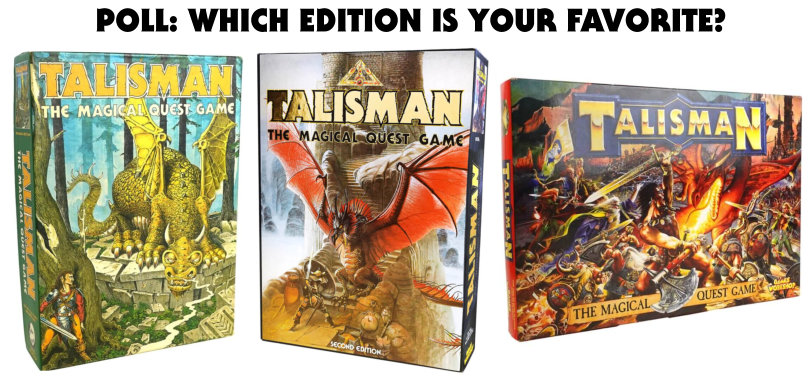
Before we take a deep dive into the different editions of Talisman: The Magical Quest Game, which one is your favorite? Please visit (and join!) the Talismanaeum Facebook page and take the short edition survey there.
Talisman 1st/2nd Edition
As enticing as Gary Chalk’s cover art for the very first Talisman product may be, almost all of the contents are better in 2nd Edition. That’s not a slam on the product, as 1st Edition is nearly as rock solid as its successor. However, having black and white cards does no justice to Chalk’s artwork on the game.
Talisman was first released with black and white cards in 1983 by Games Workshop. The 2nd edition, released a couple of years later, replaced the cover art by Chalk with a new illustration by Chris Achilleos. It’s tough to decide which box looks better – I love Gary Chalk’s old-school dragon, but the fierceness of Achilleos’ wyvern is nice, too.
My copy of the 1st Edition game comes with a fold out board, which makes sense. The 2nd Edition board comes in four different “puzzle pieces” (at least here in the US) and it often came apart on the table as gameplay progressed. Why they went this route is unknown to me, although I would bet in some way it was a cost-saving measure.
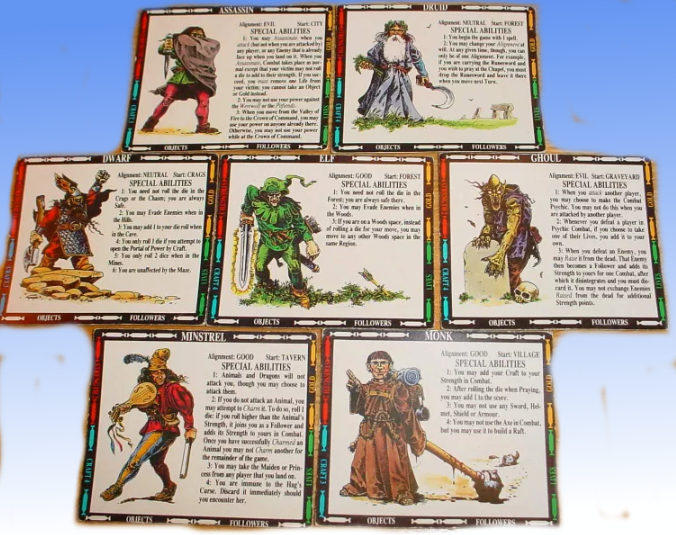
Both 1st and 2nd Edition include 14 adventurers: Assassin, Druid, Dwarf, Elf, Ghoul, Minstrel, Monk, Priest, Prophetess, Sorceress, Thief, Troll, Warrior and Wizard. While some of these characters would be replaced in the 3rd Edition base set with more Warhammer-esque characters, they will form the basis for both the 4th and 5th Edition character base in those core boxes (give or take a couple of the characters!)
Simpler than many other tabletop fantasy games, each character has simple statistics: lives, strength, craft, as well as a starting location on the board and alignment. I don’t need to elaborate much more on this, as most of you likely reading this article are well-familiar with Talisman game-play dynamics.
The end game in 1st and 2nd Edition is to make it to the center of the board to attain the Crown of Command – once there, the character launches a spell each round trying to drain all the other characters of their lives to ultimately win the game. This endgame is mirrored in the 4th Edition of the game from Fantasy Flight Games, but takes on a different tact in 3rd Edition.
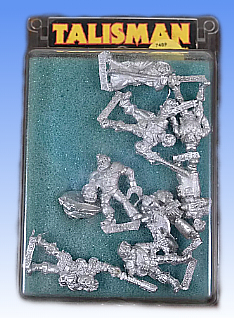
Miniatures clamshell from 2nd Edition. Back in the day, when metal minis were less than $5 US apiece!)
One of the best parts of 2nd Edition, in my opinion, is that Games Workshop released a slew of metal Citadel Miniatures to represent the card stock standees included with 2nd Edition boxes. Sadly, only the Talisman City and Talisman Dragons didn’t offer specific Citadel Miniature packs, though GW later offered “mail order” proxy options for many of them. in addition, the ultimate fan site Talisman Island offers proxies as well, designed by site creator Jon New in the Hero Forge interface.
I truly love 2nd Edition, as it set the baseline for the game for years to come and remains fun to play in 2025. TalisMatt isn’t quite the fan that I am, as he indicated that “Games Workshop should have integrated more Warhammer elements into 2E at the time, a problem they later fixed in 3rd Edition. With Warhammer ramping up to be GW’s flagship title, it’s a shame they didn’t use Talisman as an additional launch pad for their budding platform.”
With a total of 6 official expansions – the Expansion, the Adventure, the City, the Dungeon, the TImescape, and Dragons, Talisman 2nd Edition is a welcome and necessary addition to any true Talisman fan’s collection!
Pros: These are the editions that created the Talisman fan base and introduced the game we know and love. It sits nicely on the bookshelf and in the collection, as all boxes share the same size. It’s still highly playable by today’s standards and remains relevant as a good contemporary game and has collectible value.
Cons: The puzzle-style board is inconvenient, and the expansions need separate spaces on the table and don’t connect as nicely as later editions to the main game board. Also these are the only editions which didn’t include miniatures representing the characters, which may or may not be a deal breaker for some. The seperate minis are quite pricey these days.
My rating for 1st/2nd Edition: 4/5 Stars
TalisMatt’s Rating: 3.5/5 Stars
Talisman 3rd Edition
(Written by TalisMatt)
Thank you, Wally, for handing over the pen – um, keyboard – for a proper discussion of what I believe is hands-down the best edition of Talisman: The Magical Quest Game. From the boxes, the artwork and the distinct 90s Warhammer vibe, if you don’t own 3rd Edition, you’re missing out. Sadly, this is also the edition which usually takes a beating when it comes to reviewers of the game. To be completely fair, it requires a sort of nostalgia for the 90s era of Warhammer and the so-called Oldhammer vibe to appreciate it in its fullest form.
Unfortunately, this is also the most expensive edition of Talisman to collect these days, with the core game alone selling for $150-$200 (or more.) The elusive Dragon’s Tower expansion could set you back more than $400 US, especially if it is complete and contains the plastic Dragon King model. The base game was reprinted in 2004 as a limited holiday release by Games Workshop, and sometimes you can get lucky and find affordable copies of that slimmer “big box” through auction sites like eBay.
There are so many changes to 3rd Edition that it’ll be difficult to document most of them here, but I will do my best.
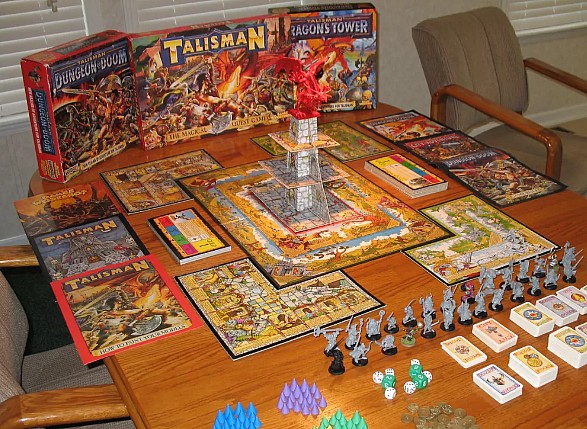
The old school Avalon Hill and SPI “bookshelf” boxes used in 1st and 2nd Edition are replaced by what might be considered “modern” box sizes – the “big box” containing the core set is similar in size to the Warhammer Fantasy and 40K core boxes, while the three expansions – Dungeon of Doom, City of Adventure and Dragon’s Tower – come in boxes that match quite nicely with Fantasy Flight’s 4th Edition Talisman core game box (and the 4th edition “big box” expansions).
The tiny character cards from 1st and 2nd Edition have been replaced by much larger cardboard stock cards. These cards make it much easier to sort out followers, objects and life/craft/strength counters. Counters have been made into little cones. The cones stack nicely on the life, craft and strength markers on each character card.
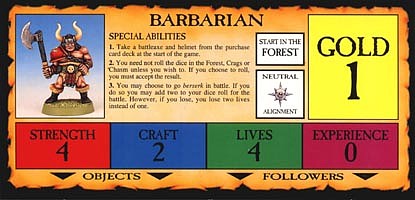
The characters themselves have been replaced by their Warhammer-esque counterparts – some of them, in fact, pulled directly from different Warhammer armies! The 3rd Edition core game includes 11 character cards, along with beautifully sculpted Oldhammer miniatures. The characters in 3rd Edition core include: Barbarian, Dwarf Warrior, Goblin Fanatic, Knight Templar, Minotaur, Ranger, Skaven, Swashbuckler, Warrior, Wizard and Wood Elf.
The cards for gameplay are now smaller, but feature a high gloss and have rounded corners.
The nice kitschy artwork by Gary Chalk has been replaced by card and board art that more effectively reflects the growing Warhammer vibe – Wayne England is largely responsible for the cards in the core box, as well as the completely re-drawn main game board. Some detractors like to joke about the ridiculous amount of “skulls” that litter the game board – they’re everywhere! This is a sticky spot for people who prefer a more “generic” fantasy look to the game, and they’re not entirely wrong. But if you’re envisioning Talisman as an official Games Workshop “Warhammer spin off” product, it hits the nail on the head.
The game is simplified in many ways. It’s easier to get into the middle region and the end game can happen much faster not only in the core box but with the expansions, too. The Dragon’s Tower expansion is a joy to behold on the game board, and it creates a sense of awe-inspiring appreciation when its assembled and painted on the tabletop with all of the corner expansions attached. It’s also the most aesthetically complete, edition, in my opinion.
If you love the older editions of Warhammer, and want a Talisman game that won’t take 3-5 hours of your time on a weekend, 3rd Edition is worth checking out. It’s also my favorite edition, by far, if I haven’t made that abundantly clear.
Pros: Beautiful Warhammer-style miniatures, bigger character cards, nicely redone artwork to fit the GW aesthetic of the time, and a sense of completeness and simplification to the game.
Cons: Some people don’t like the artwork and consider it “campy”; the game is complete with all of its expansions and leaves little room for creative expansion by fans, and it seems directly marketed to GW enthusiasts.
What some people find problematic about this edition are what I believe gives it its charm and appeal.
My rating for 3rd Edition: 5/5 Stars
Wally’s rating 3.5/5 Stars
Talisman 4th Edition Revised
And now the torch is handed back to me (Wally) for a look at the 4th Edition of Talisman, and I won’t spend as much time detailing this as I did the earlier editions. Many of you jumped on the Talisman wagon with the inception of 4th Edition, and its no wonder.
This game was created during what I consider a Golden Age at Fantasy Flight Games, a time when their in-house fantasy range of Terrinoth – and their licensed Games Workshop properties – received most of the company’s attention.
Fantasy Flight very quickly fixed what was broken in Black Industries’ initial release of 4th Edition, which featured oddly shaped cards, not the best typesetting, and a lack of miniatures and nice conformity within the original box. They even created a “4th Edition Revised Upgrade” set, which added miniatures, fate tokens, and an updated rules set to the original 4th Edition release.
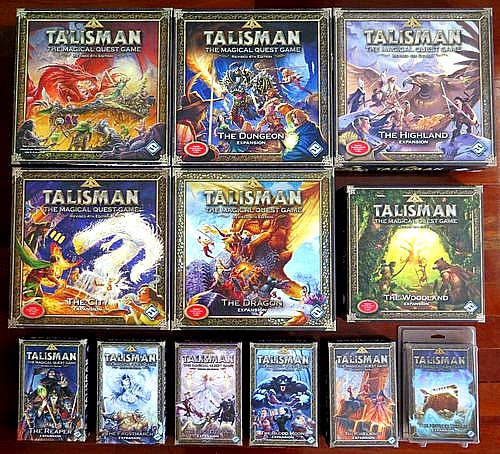
In addition, for collectability, 4th Edition hosts the absolute largest number of both official AND fan expansions for the game. You could easily spend your entire gaming hobby collecting everything available for this edition alone!
Published by FFG initially, Games Workshop got their intellectual property back in 2017, and re-released their own reprints of the core game and five of the expansions. Pegasus Spiele then picked up the 4th Edition Revised branding, and re-released everything. They even created new box art for the Lost Realms expansion, which collected both POD expansions from Fantasy Flight games, the Nether Realm and the Deep Realms.
Plus, the miniatures – they’re all very nice, with very few notable exceptions.
Pros: 4th Edition Revised picks up elements from both the original 1st and 2nd Edition, as well as some of the better aspects of 3rd Edition. It is a well-balanced version of the game, and appeals both to old-school fans and newcomers alike. Its expandability creates limitless opportunity for new adventures, and fans keep creating new characters and expansions for the game.
Cons: It’s out of print. I can’t think of many more.
My rating for 4th Edition: 5/5 Stars
TalisMatt’s rating 4.5/5 Stars
Talisman 5th Edition
Talisman came full circle with a new edition – its 5th iteration – in 2024. A more simple, family friendly game, it appears to be largely well-received in the community, although some of us grognards might take issue with some of the game change mechanics.
Gone is the tragedy of becoming a toad – its no longer nearly as detrimental to a win as it was in 2nd-4th Edition. And defeating the Dragon King – rebilled as the Elder Dragon – is now the end goal of the game, which pulls in a fun mechanic from the 3rd Edition of the game.
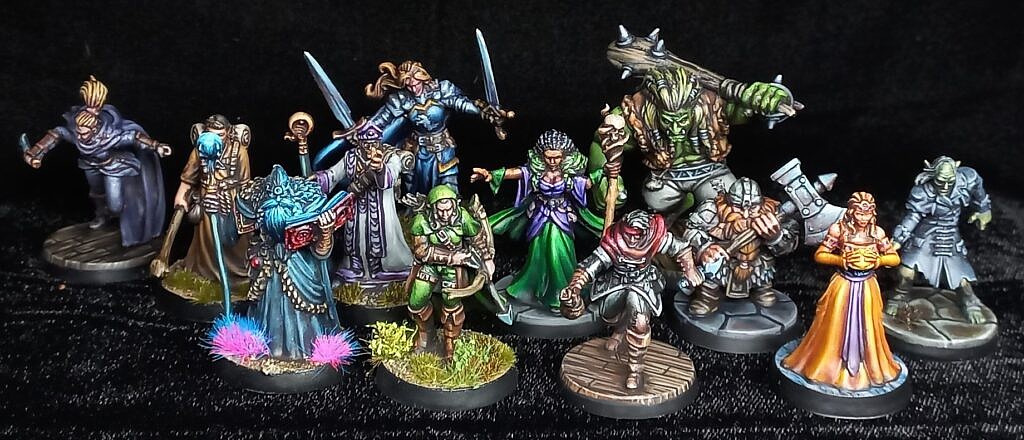
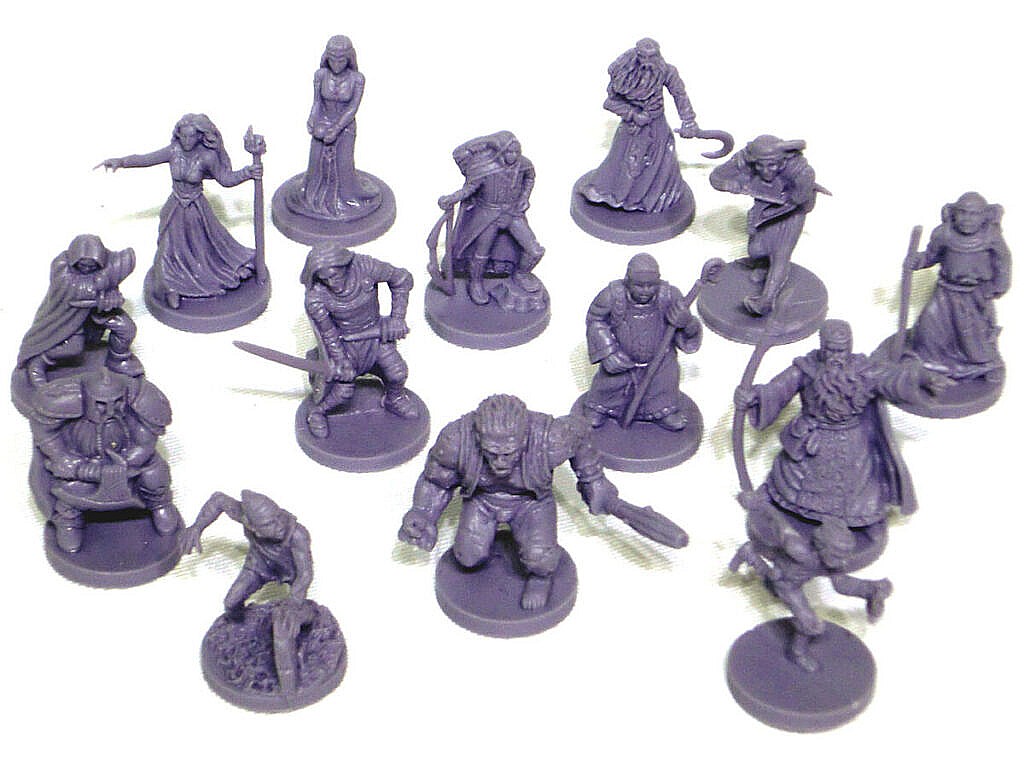
Avalon Hill’s comes with some of the most beautiful miniatures ever produced for the Talisman board game, as you can see from the image above. The game already has spawned an expansion for cooperative gameplay, Talisman: Alliances “Fate Beckons” – and a new expansion, Talisman: Nemesis, has been leaked for potentially summer of 2025.
With a very low entry price point, the 5th Edition game is available for a mere $49.95, which is great considering the 12 miniatures alone cover the cost of admission. Add to that a large number of game tokens, character cards and a beautiful (but strangely inverted) game board, and it’s a steal at the asking price.
I’ll admit that I am a “grognard” (i.e. an old school gamer who prefers previous or older editions of board games) but I am NOT a “gatekeeper” by any means (i.e. someone who thinks the hobby should only be open to people who agree with their opinions and hate to see change). It’s completely exhilarating to see a great opportunity like this for new fans to discover the world and mechanics of the Talisman legacy board game. Long live Talisman!
Pros: The edition is too new to see how it will shake out with fans, but Avalon HIll seems off to a good start. I hope and pray that AH supports the game with many new expansions, akin to the Fantasy Flight approach. The miniatures are absolutely top notch, and the component quality is on par with the best of what has come before.
Cons: Thus far, it seems as if Avalon Hill is steering clear of reprinting the old expansions from previous editions and moving in new directions. While some enjoy and appreciate the co-op aspect of the game through the Alliances expansion, I prefer the challenge of facing off against other players. Personal preference or not, I hope co-op remains an option and not the focus of the new edition. The future is wide open; let us see what awaits us down the road!
My rating for 5th Edition 4/5 Stars
TalisMatt’s rating 3.5/5 Stars
What is your favorite edition of Talisman? Sign up for a Talismanaeum account and tell us below!
As always, I am –
Wally (AKA The Paint Monk)